
- May 11, 2026


Modern onchain systems don't behave like the ones traditional security models were built for. Code ships continuously, architectures evolve, and a clean security report from six months ago says little about a system today. Most of the largest recent hacks haven't come from missed smart contract bugs but from off-chain attacks: operational failures, key management lapses, and vulnerabilities in code shipped between audits, vectors that fall outside what traditional security audits cover.
This is the security challenge established blockchain companies and institutions building onchain actually face. They need coverage that matches how their systems operate: continuous, lifecycle-spanning, and grounded in deep technical expertise. The security model has to keep up with the pace of modern development.
Today we're introducing the OpenZeppelin Continuous Security Program: a subscription-based engagement model that closes the gaps left by point-in-time audits with always-on coverage. A decade of OpenZeppelin security standards and expertise, scaled by AI-native, agent-augmented workflows, delivered as an ongoing partnership across the full security lifecycle.
The Problem With Point-in-Time Security
Smart contract security has operated on the same model for a decade: write code, freeze it, send it for audit, wait weeks, get a report, fix the findings, ship. Repeat next quarter.
The industry's most significant exploits, billions in losses, didn't happen because audits missed something. They happened in code that was added or modified after the last review shipped. Upgrades, parameter changes, new integrations, dependency updates, all pushed to production without security review. And code is only part of the exposure.
Misconfigured access controls, compromised keys, and operational missteps fall outside the scope of a traditional audit entirely, yet they account for some of the largest losses in the industry.
The gap is between audits, and between code and the systems that surround it. For teams shipping frequently, that's thousands of lines of unreviewed code and an expanding operational surface accumulating silently between engagements.
Point-in-time audits remain essential. They were designed to review code at a moment in time, as a snapshot in a world that moves continuously. That is exactly the gap a continuous program is built to close.
Continuous Security Across The Full Lifecycle
The Continuous Security Program is structured around four areas of coverage that span the full development lifecycle. Each addresses a specific category of risk that onchain systems face today.
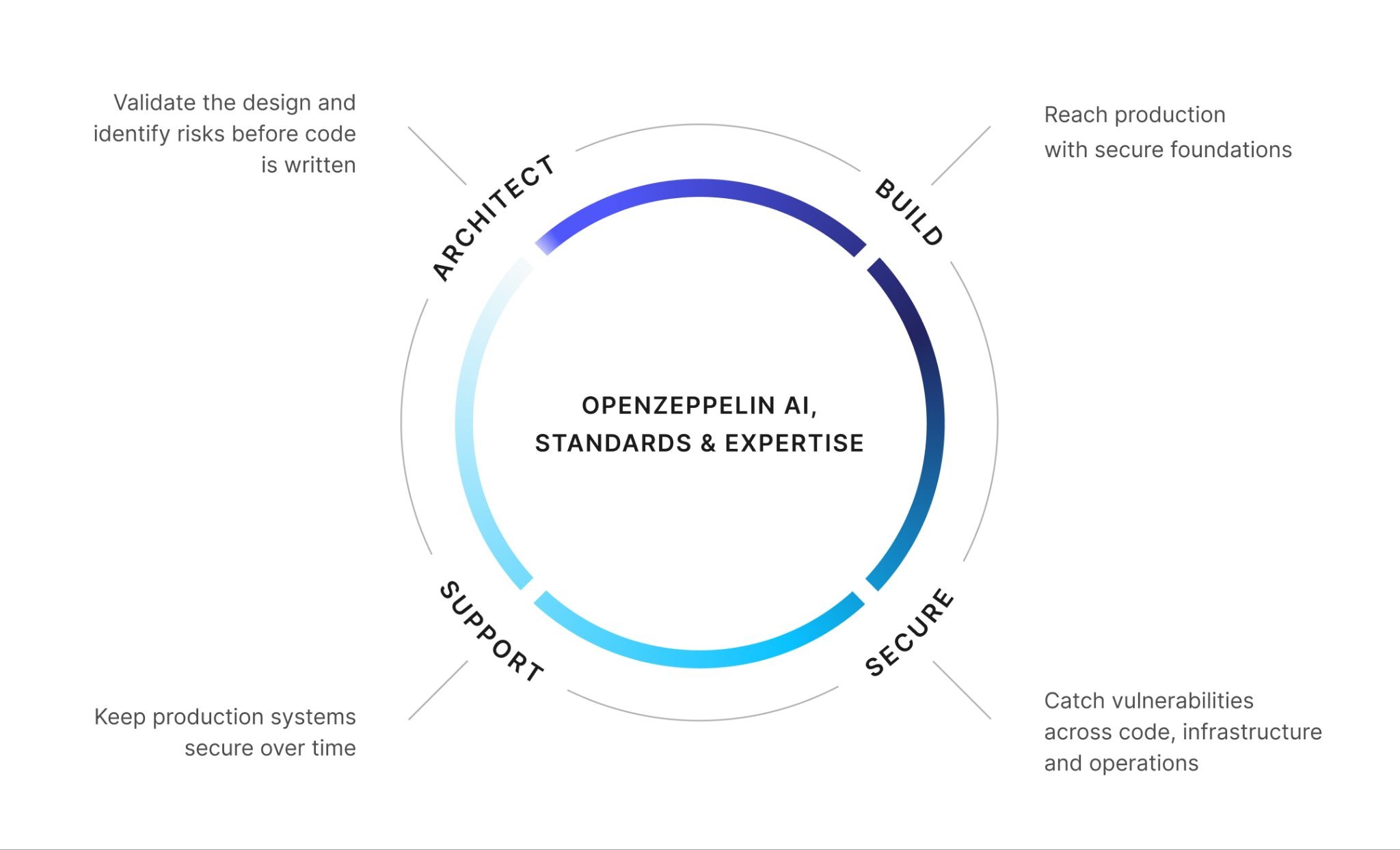
- Architect. Validates the design and identifies risks before code is written, so structural issues are surfaced when they are still cheap to fix and architectural decisions can be made with full visibility into security implications.
- Build. Provides the secure foundations of production systems, drawing on the libraries, standards, and platform expertise that already underpin the majority of onchain finance.
- Secure. Catches vulnerabilities across code, infrastructure, and operations through continuous, agent-augmented analysis combined with senior researcher judgment, so issues are caught and triaged early before they reach production.
- Support. Keeps production systems secure as they evolve, through embedded security expertise, monitoring, and incident readiness. Security work continues after deployment.
These aren't sequential phases. Real engagements move across them continuously, in any direction, as systems evolve. The Program treats them as a flywheel: ongoing partnership across all four, with motion driven by what your protocol actually needs at any given moment.
Security becomes a continuous layer across your development lifecycle, from first commit through deployment and beyond.
A Decade of OpenZeppelin Security Standards and Expertise
OpenZeppelin has been the security standard for onchain systems since 2015. We wrote the Contracts library that 9 of the top 10 stablecoins by market cap and 10 of the top 10 tokenized money market funds by market cap are built on. Over $35 trillion has been transferred through the Contracts ecosystem. We've conducted 900+ audits, identified 10,000+ vulnerabilities, and secured $250 billion in onchain value across protocols and institutions defining the industry, including Aave, Uniswap, Fidelity Digital Assets, DTCC, the Ethereum Foundation, BitGo, ZKsync, WisdomTree, and more.
That body of work is the foundation everything in the Continuous Security Program is built on. Every architectural decision, every audit finding, and every operational pattern we've reviewed across a decade of institutional and protocol engagements informs how we deliver security today.
OpenZeppelin AI Auditor: How a Decade of Expertise Scales
OpenZeppelin AI Auditor is how that decade of security expertise scales across continuous coverage. It is the tool of choice used by OpenZeppelin's own security researchers across every engagement. We built it to solve our own problem first: how do you apply a decade of audit expertise across thousands of lines of code, continuously, without compromising on rigor?
It reasons about smart contract risk the way our researchers do, because it was built by the team behind 900+ audits, $250 billion in onchain value secured, and 10,000+ vulnerabilities identified across both off-chain and onchain systems. The same researchers who wrote the most widely adopted smart contract libraries in the industry continuously refine how AI Auditor evaluates code, threat patterns, and attack vectors. It's the product of a decade of hands-on security research, encoded into AI.
What that means in practice:
- Repository-level reasoning: AI Auditor understands dependencies, underlying infrastructure, cross-contract interactions, and system-wide risk, beyond individual functions.
- Built by auditors, refined by auditors: every workflow, triage output, and finding format is designed for how our researchers actually work. Detection patterns are continuously refined from active engagements and emerging research, ahead of public exploits.
- Trained on a decade of curated audit intelligence: AI Auditor draws on validated, severity-classified findings from a decade of human-led institutional audits, curated by the experts who produced them. The result is signal quality you only get from real engagements.
- Built for recurring use: roughly one in three AI Auditor scans surfaces a high- or critical-severity finding. Customers run AI Auditor as a recurring part of their workflow, including audit-prep engagements and ongoing-assurance programs.
- Model-agnostic architecture: as frontier AI models improve, AI Auditor upgrades instantly. You benefit from the best available models without waiting for a product cycle.
The Adaptive Delivery Model
The Continuous Security Program combines three capabilities, dynamically adjusted based on your system's architecture and risk profile.
Senior security researchers lead every engagement. The same team that built OpenZeppelin Contracts and conducted 900+ audits delivers your security work directly. They uncover complex logic vulnerabilities that require contextual understanding, validate and prioritize findings, and deliver clear, actionable remediation guidance with protocol-specific expertise.
Expert lead oversight provides continuous strategic involvement from a senior researcher assigned to your program. Findings are correctly prioritized, aligned with real-world protocol risk, and connected to architecture and threat modeling guidance. Your security advisor over time, beyond a single audit engagement.
OpenZeppelin AI Auditor scales researcher coverage continuously across the full codebase. Triage and prioritization stay on our team: noise stays with us, signal goes to your researchers.
The result is depth no AI alone can deliver, at a scale no human-only model can sustain.
What Changes For Your Team
Most teams today experience weeks between security feedback cycles. Audits review a snapshot, and everything between engagements is a blind spot. Coverage requires significant researcher time, issues are found late when they're expensive to fix, and each new audit starts from scratch with no institutional memory from the last one.
With the Continuous Security Program, that changes:
- Continuous security feedback on every change: code is monitored as it ships, beyond scheduled audit windows. The blind spots between engagements close.
- Coverage extends past deployment: production systems stay covered as they evolve. Security work continues through monitoring, incident readiness, and embedded expertise after a report is delivered.
- AI handles breadth so researchers can focus on depth: senior researcher capacity goes to the issues that require human judgment. The model scales with your codebase as it grows.
- A decade of security expertise compounds across engagements: every engagement applies what we've learned across 900+ audits and 10,000+ findings. Each one makes the next one sharper.
- Faster scheduling, predictable capacity: continuous Security Program engagements come with reserved researcher capacity and priority access, so security work doesn't stall behind project queues.
The result is fewer surprises in production, cleaner formal audits, and a security posture that strengthens with every deployment.
Built for Institutional Standards
For financial institutions and regulated enterprises, continuous security isn't a new idea. It's the standard cybersecurity model. What's been missing is a partner that brings that model to blockchain with the technical depth, the institutional controls, and the engagement structure regulated environments require.
The Continuous Security Program covers more than smart contract review. The program includes Technical Risk Assessments, Operational Security Assessment, Standards and Regulatory Review, Governance Design, and more, to produce the auditable evidence base that risk committees, supervisors, and counterparties increasingly require.
SOC 2 Type II compliance, data privacy protections, and dedicated support are built in, with the same controls that already serve Fidelity Digital Assets, DTCC, WisdomTree, and other institutional partners.
Get Started
The OpenZeppelin Continuous Security Program is available now for teams building on blockchain. Whether you're a DeFi protocol shipping fast or a financial institution building with institutional-grade requirements, we'll design an engagement that fits how you work.